
My High School French instructor, Mr. Bechtel, had a lot of stories for his class but one he told us more than once was the situation of school children in the disputed areas of France and Germany and how their primary language instruction would shift from German, to French, and back to German. This was especially the case in the area of Alsace, but it also applies, to a lesser degree, to the Mainz-Bingen district of Germany, which I tell here because my Great-Great-Grandfather immigrated from Ingelheim to the United States in 1868.
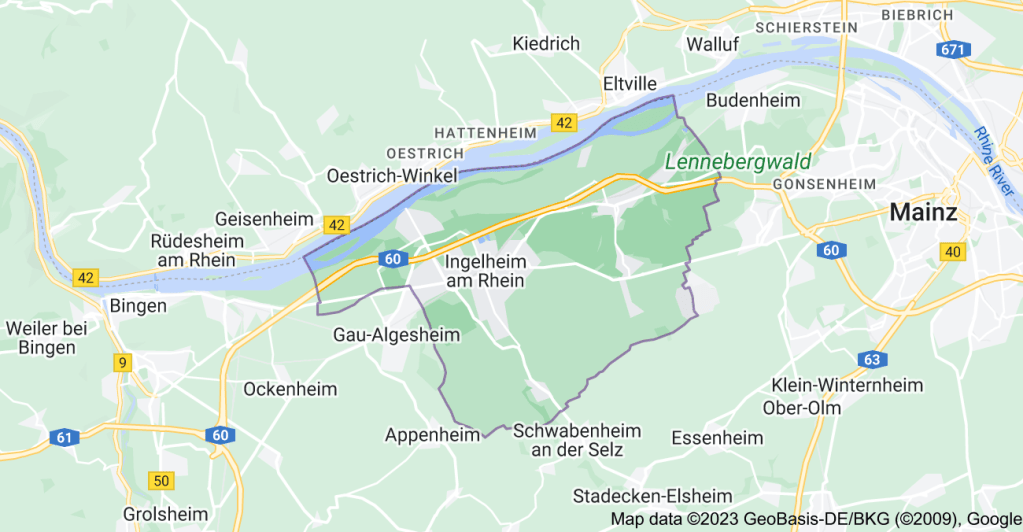
Ingelheim am Rhein, or informally, Ingelheim, is a town in Mainz-Bingen, Rhineland-Palatinate, Germany. Over the centuries, the town has been variously under German and French governments. Based on the Frankish suffix -heim The area was probably established as a community by the sixth century and Ingle is probably based on the Frankish surname Iniglio. The Franks, as you probably know, are the root source for the etymology of France, Francia being the latinized name for Land of the Franks and France is derived from Francia.
In the eighth century, the area became important as a center for the government of the Frankish Empire. Charlemagne ordered the Ingelheim Imperial Palace to be built there, which was constructed between 780 and 800. The palace was subsequently used by various Kings and other rulers until the eleventh century.
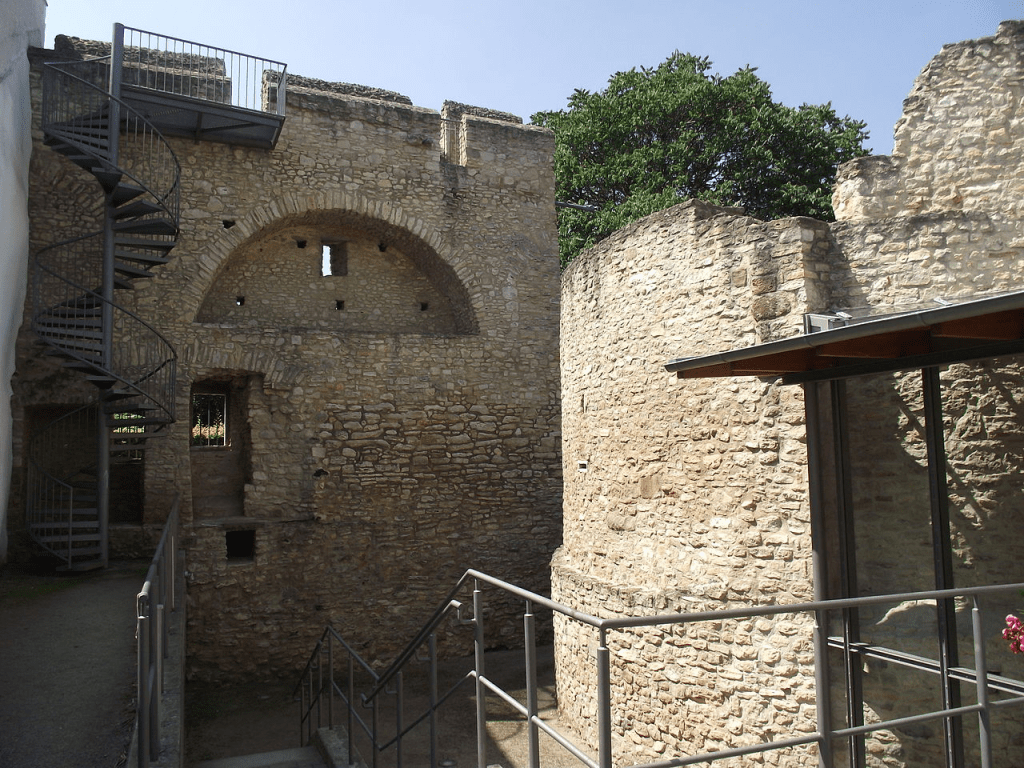
There was a period of wars following the death of Charlamagne’s son, Louis the Pious, who died in the Imperial Palace at Ingelheim in 840. The Carolingian empire was divided among Louis’ three sons in the Treaty of Verdun. The signatories to the treaty placed the territory that includes Ingelheim in East Frankia with Louis II as its king. Louis II had been previously granted Bavaria by his father. As grandson to Charlemagne, Louis was distinctly a Frank and was only posthumously assigned the epithet The German. The successor to Louis II was also a Frank. In 911, the combined Dukes of Saxony, Franconia, Bavaria and Swabia voted for Conrad the Younger to be King of East Francia. Conrad was of Frankish descent, but he is still considered the first German ruler of East Frankia. His Germanic successor, Otto I, was a Saxon and eventually had himself crowned Holy Roman Emperor. From this point, the area was under German rule through various political bodies until the nineteenth century.
German rule of the area that included Ingelheim was suspended during the expansion of France under Napoleon whose army seized the west bank of the Rhein in 1794. Political proceedings stretched out for three more years. Ingelheim was assigned to the French Department of Mont-Tonnerre (known as Donnersburg by the mostly German inhabitants) and was designated the Canton of Ober Ingelheim. This is shown in the following three images.
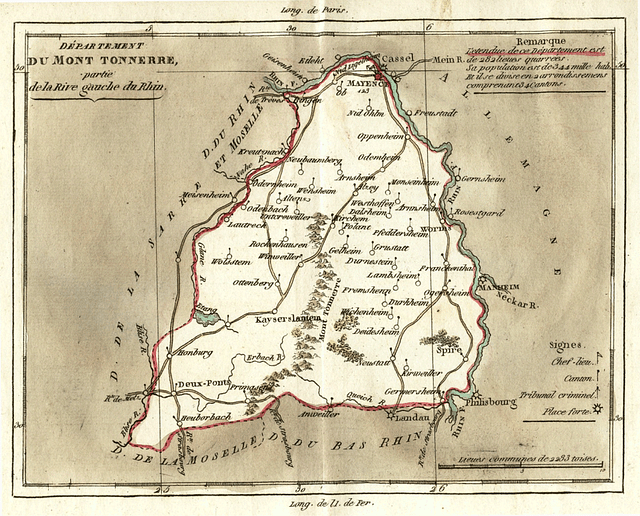
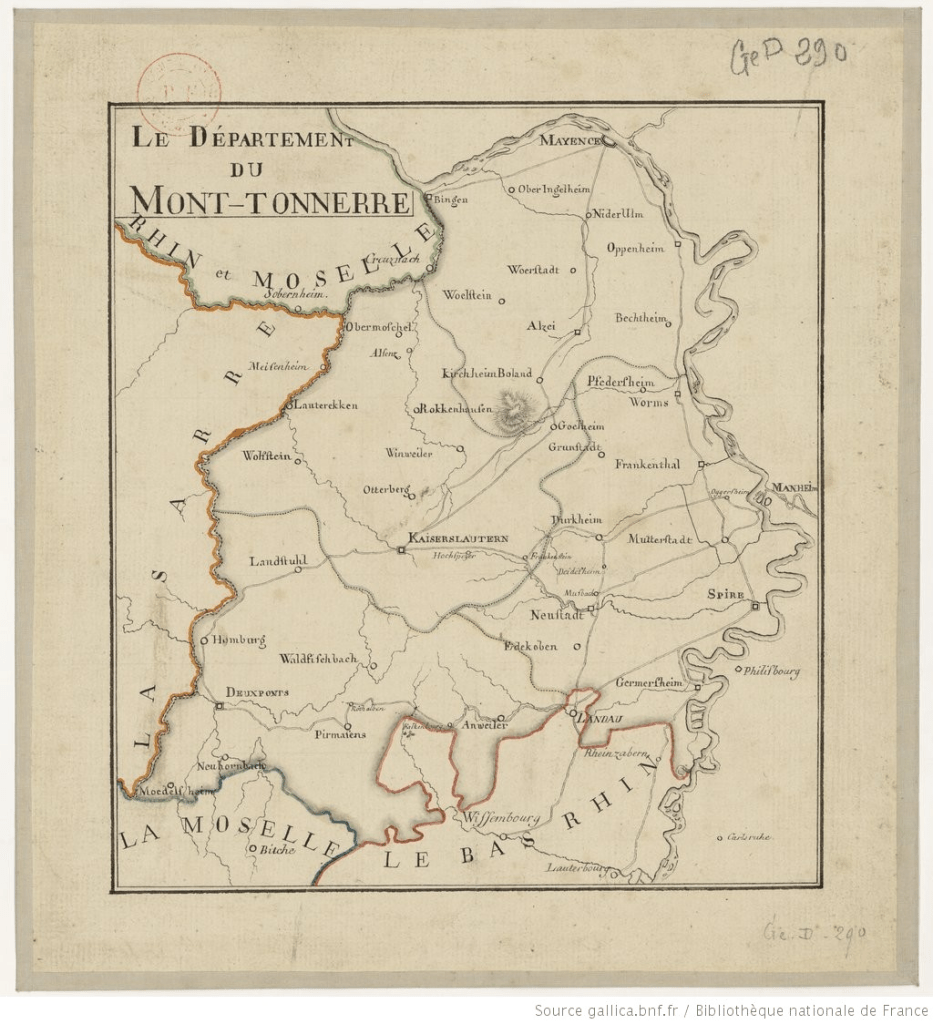
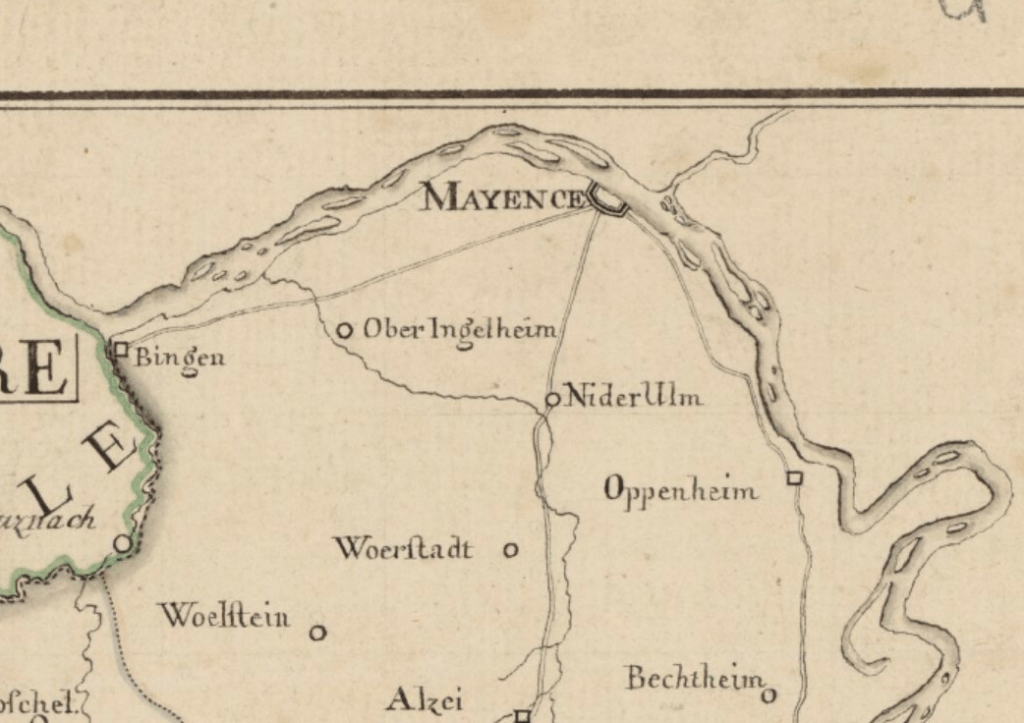
The use of Ober Ingelheim, along with other German names, including the Hessian rendering of Mainz as Mayence on the map, indicates the majority of the population were German speakers and a decade or so hadn’t displaced the long standing German culture. Despite ancient French origins, the area had been German for around 880 years. After Napoleon was defeated, Ingelheim was assigned to the Grand Duchy of Hesse and by Rhine (Großherzogtum Hessen und bei Rhein) in the German Confederation.
Since 1815, Ingelheim has remained in the various political units of Germany, but was occupied by the military of other countries after the both world wars. Following World War I, French forces occupied the Ingelheim area until 1930. Toward the end of that period, there were also British troops stationed there. Another foreign occupation of the Ingelheim area occurred in March 1945 when the US military forces arrived as part of the allied offensive against the Nazi government. The chief municipal inspector (stadtoberinspektor), Friedrich Weitzel, surrendered the city to the American troops. The United States then turned over this area to the French army, who remained in control until West Germany was formed as a state in May of 1949.
Although Ingelheim was not heavily bombed during World War II, the rise of the Third Reich saw major disruptions to Ingelheim both politically, culturally, and ethnically. Representatives of the National Socialist German Workers’ Party, who were politically fascists, seized power and deposed the democratically elected mayors. Like the rest of Germany, opponents of the Nazi party were persecuted in Ingelheim and ethnic minorities were targeted. After the Christalnacht pogrom in 1938, the nearly 100-year old Jewish Synagogue was destroyed. The Nazis took the property of Jewish people and forced many to emigrate. The area had a Jewish minority that peaked in the mid-1800s. Following World War I, only a few dozen remained. But some stayed until the few remaining Jewish families were deported to extermination camps in 1942. Only one person survived. Sinti Roma were also killed.
Ingelheim am Rhein was formally recognized as a town in 1947. This action combined the upper and lower villages as well as Frei-Weinheim. Following 1939, the population has grown at a slow but steady rate. Ingelheim became the seat of government for the Mainz-Bingen District in 1996. Today the population is young and ethnically mostly German. Emigrants from Turkey are the largest minority at just over one percent of the population. The two main political parties are the Christian Democratic Union and the Social Democratic Party, which had played a significant role in the 1918 German Revolution. The SPD was also the only party present in the Reichstag to vote against the Enabling Act of 1933. The CDU was founded in 1945. Ingelheim has a number of industries in healthcare and energy sectors as well as playing a center for regional fruit and vegetable growers as well as the Ingelheimer Pinot Noir wines.
_________________
Note: When exploring German history, it is impossible to not address the Nazi party. The town official named Frederich Weitzel who surrendered Ingelheim to the American Army was certainly a Nazi party member. I have no known relation to anyone named Frederich Weitzel. I strongly denounce the Nazi party, their xenophobia, and everything they represent.
Note: I have only a little German language skills. The translations for German sources linked here were made using Google Chrome. I provided the translations from French. I have also relied heavily here on encyclopedic sources. My intent is to illustrate the complex political history of the Ingelheim region at a macro level and in a different way than previously available. I was not intending to conduct new research.

 On Diverse Arts and Sciences